

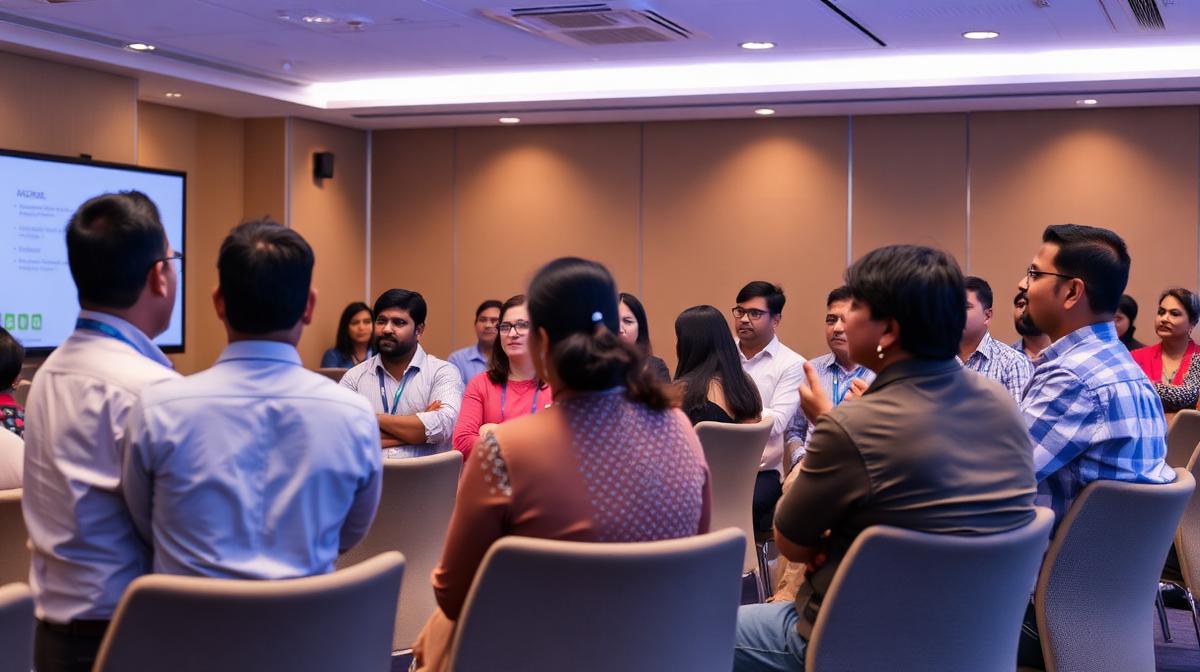
Corporate training programs in India are structured learning initiatives designed to develop employee skills, behaviors, and performance within organizations. They should create measurable change, but most don't. I've seen this firsthand across 15 years of training rooms.
Corporate training programs in India are structured learning initiatives designed to develop employee skills, behaviors, and performance within organizations. They should create measurable change, but most don't. I've seen this firsthand across 15 years of training rooms.
I remember a session I ran for a large IT company in Bangalore. The HR head told me they'd spent lakhs on training that year. When I asked what changed, she couldn't name one behavior shift. That's the problem. Training becomes a checkbox activity, not a transformation tool.
One of my participants, a senior manager at an automotive firm, put it bluntly. 'We do training because everyone does training,' he said. 'But my team still can't handle client escalations better.' That's why I started MVIBE. We don't do training for training's sake.
What Happens When Training Ignores Real Workplace Challenges?
Most programs teach generic skills disconnected from daily work. I've seen modules on 'effective communication' that never address how teams actually talk in meetings. Or 'leadership' sessions that ignore the pressure Indian managers face from both global HQ and local teams.
In a pharma company session last year, I asked sales managers to list their top three communication problems. Every single one mentioned 'saying no to doctors without offending them.' Yet their previous training had covered 'active listening' and 'presentation skills' only.
Training must start with real problems, not theoretical frameworks. At MVIBE, we spend days understanding specific team dynamics before designing any program. That's why our corporate training programs at mvibeon.com get results where others fail.
Why Do Teams Forget Everything After a Training Workshop?
The forgetting curve is real. Research from the Journal of Applied Psychology shows people forget 70% of what they learn within 24 hours if not applied. I see this constantly. Teams attend a great session, feel motivated, then return to old habits by Monday.
Traditional training treats learning as an event. Modern training treats it as a process. Here's the difference that actually works.
- Traditional: One-time workshop with follow-up email
- Traditional: Generic content delivered to all teams
- Traditional: Trainer leaves after session ends
- Modern: Pre-work identifying specific team gaps
- Modern: Customized scenarios from their actual projects
- Modern: 90-day application support with check-ins
I implemented the modern approach with a financial services client. We didn't just teach negotiation skills. We used their actual client cases. Then we did weekly practice calls for three months. Their deal closure rate improved 23% in that quarter.
How Can You Measure Training Impact Beyond Smile Sheets?
Training Measurement Reality Check
85%
Of Indian companies still measure training success through participant feedback forms only (LinkedIn Workplace Learning Report 2025)
12%
Actually track behavior change 30 days post-training in my experience across 200+ Indian organizations
3:1
The ROI ratio companies achieve when they measure application, not just satisfaction, based on McKinsey 2024 analysis
Smile sheets - those feedback forms - tell you if people liked the trainer. They don't tell you if anything changed. I've gotten perfect scores on sessions where nothing actually shifted in the workplace. That's dangerous validation.
Real measurement looks different. Did conflict resolution time decrease? Did customer complaints drop? Did meeting efficiency improve? These are harder to track, but they're what matters. At MVIBE, we build these metrics into every program from day one.
What's Missing in Most Indian Corporate Training Culture?
Indian organizations often treat training as a perk or punishment. High performers get sent to 'reward' them. Low performers get sent to 'fix' them. This creates resistance before the session even begins. I've walked into rooms feeling this energy.
One manufacturing company I worked with had a brilliant approach. They made training part of project planning. Before starting a new export initiative, the entire team went through cross-cultural communication training. Not as a reward, but as preparation.
Culture eats strategy for breakfast, as the saying goes. It also eats training programs. If the workplace doesn't support trying new behaviors, people won't. I tell leaders: Your reaction to the first mistake after training determines if change happens.
“Training doesn't fail in the classroom. It fails in the first team meeting back at work when someone tries something new and gets shut down.”
Can Technology Fix Broken Training Approaches?
LMS platforms and AI coaches are everywhere now. They're tools, not solutions. Harvard Business Review noted in 2025 that technology amplifies existing approaches - good or bad. If your training design is weak, tech just delivers weak content faster.
I've seen companies invest in fancy platforms while keeping the same outdated content. It's like serving stale food on silver plates. The 2024 Gallup State of the Workplace India report found that digital learning adoption increased, but skill application didn't.
Technology works when it supports human connection, not replaces it. We use simple tools at MVIBE - WhatsApp groups for practice, video recordings for self-review. The magic happens in the live sessions where real breakthroughs occur.
- Identify 3 specific behaviors that must change
- Design practice scenarios from actual work situations
- Schedule weekly 15-minute team practice sessions
- Track one metric that proves business impact
- Celebrate small wins publicly when changes occur
These aren't complicated. But they require commitment. Most companies want the certificate of completion, not the behavior change. That's why I'm direct in my sessions. I tell participants: 'This will be uncomfortable. Growth always is.'
I worked with a retail chain struggling with customer service. We didn't do a 'customer delight' workshop. We filmed their actual store interactions. Then we practiced specific phrases for common situations. Role-play felt awkward at first. Then it became natural.
Their customer satisfaction scores jumped 18 points in two months. Not because we taught theory. Because we drilled reality. That's the approach we take at mvibeon.com for all our corporate training programs.
Senior leaders often ask me for the 'best' training program. I tell them there isn't one. What works for a startup won't work for a 100-year-old family business. What transforms a sales team might confuse an engineering team.
Context is everything. I've delivered similar content to IT and healthcare companies. The examples, the language, the pace - all different. The core principles might be the same, but the application must fit the soil it's planted in.
- Stop treating training as an annual event
- Start small with one team and one skill
- Involve managers in design, not just approval
- Measure behavior, not happiness
- Budget for practice time, not just workshop time
These shifts seem simple. They're not easy. They require challenging how things have always been done. But I've seen companies make these changes and get remarkable results. The ones that don't will keep wasting money and wondering why nothing changes.
After 15 years in this field, I'm convinced of one thing. The future of corporate training programs in India belongs to those who focus on application, not information. Who measure change, not attendance. Who understand their specific people, not generic best practices.
Frequently Asked Questions
How long should a corporate training program last?
Duration depends on the skill. Simple tools can be taught in hours. Behavior change needs months. At MVIBE, our shortest program is 4 hours for specific tools. Our behavior change programs run 8-12 weeks with consistent practice.
What's the biggest mistake companies make with training budgets?
Spending 90% on workshop delivery and 10% on follow-up. It should be the opposite. Real change happens after the workshop. Budget for coaching, practice sessions, and measurement systems, not just trainer fees and venue costs.
Can online training be as effective as in-person?
For information delivery, yes. For behavior change, no. I've run both formats for years. Online works for knowledge transfer. In-person creates the psychological safety needed for trying new behaviors. We blend both at MVIBE strategically.
How do you handle resistant participants?
I don't try to convince them. I involve them. Resistant people often have valid concerns. I ask them to share what hasn't worked before. Then we design solutions together. Resistance usually comes from past bad experiences with training.
What industries in India need training most urgently?
All industries need it, but differently. IT needs collaboration across global teams. Manufacturing needs safety communication. Banking needs compliance conversations. Healthcare needs empathetic patient interactions. Generic programs fail all of them.
How do you customize training for different experience levels?
By focusing on application complexity, not content difficulty. A junior employee and senior leader might both need communication skills. The junior practices clear updates. The senior practices difficult feedback. Same skill, different application level.
What's one thing HR should stop doing with training?
Forcing attendance. Voluntary programs with waiting lists work better than mandatory ones. When people choose to attend, they engage differently. I've seen participation quality double when it's optional but highly recommended by peers.
How do you prove training ROI to leadership?
Connect it to existing business metrics. Don't create new 'training metrics.' Show how communication training reduced project delays. How leadership development improved team retention. Use their language, not training jargon. That's what gets budgets approved.
If you're tired of training that doesn't stick, let's talk. At MVIBE, we don't deliver workshops. We design behavior change journeys. Visit mvibeon.com to see case studies of Indian companies that transformed team performance. Or reach out directly. I still run many sessions myself because I believe in the work. Let's build training that actually works for your people and your business.